A direct picture of the cosmic web, caught between two quasars
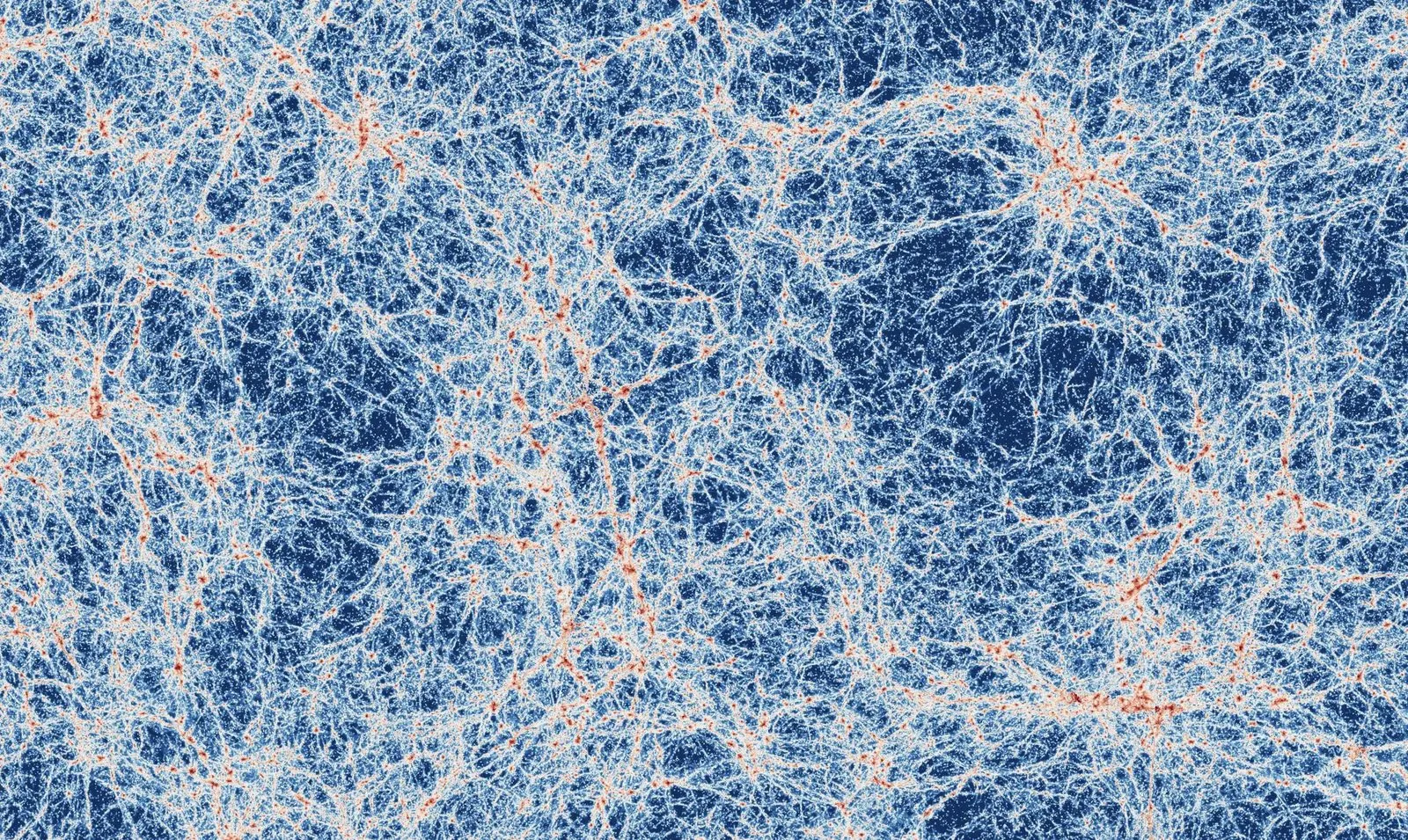
For fifty years, cold dark matter theory has predicted that the universe is threaded by a web of filaments — thin bridges of gas and dark matter along which galaxies assemble. The prediction is old and central. Photographing it is another matter: filaments are expected to glow at about a hundred-millionth of the brightness of the night sky, far below what telescopes could reach.
We spent 142 hours pointing MUSE at a single patch of sky containing two quasars, and the filament between them came out of the noise.
The structure stretches roughly 700 kiloparsecs — a couple of million light years — and connects the two quasar host galaxies at redshift 3.22, when the universe was under two billion years old. Its surface brightness is about 8 × 10⁻²⁰ erg s⁻¹ cm⁻² arcsec⁻², which is to say faint enough that no previous survey would have registered it at all.
Depth of that kind buys more than a detection. It buys a measurement. Because the filament is resolved rather than merely present, we could trace how the emission falls off along its spine and across it, and find where the gas belonging to each galaxy ends and the intergalactic medium begins. That boundary sits at about 100 kiloparsecs from the two quasars — roughly the virial radius of their haloes, and one of the very few times this transition has been measured directly rather than inferred.
The gas itself turns out to be extremely thin: of order 10⁻³ hydrogen atoms per cubic centimetre, a few tens of times denser than the cosmic average and no more. When we looked for comparable quasar pairs in cosmological simulations, the filaments connecting them had the same characteristic density. The prediction and the photograph agree.
What makes this worth the exposure time is not the single object. It is that a filament can now be treated as something to measure — a structure with a profile, a width and a density — rather than a line drawn between points in a simulation.