Glowing filaments are common wherever galaxies crowd together
We recently observed a single filament of the cosmic web, stretched between two quasars in the MUSE Ultra Deep Field. One filament is a proof of principle. The obvious next question is whether such structures are rare exceptions, lit up by unusual neighbours, or the normal state of affairs wherever galaxies gather.
To find out, we combined two of the deepest observations ever taken with MUSE, the MUSE Ultra Deep Field and the MUSE Extremely Deep Field, more than 250 hours of exposure between them, and analysed both in exactly the same way. Instead of following quasars, we followed ordinary galaxies: young, star-forming objects that shine via hydrogen emission.
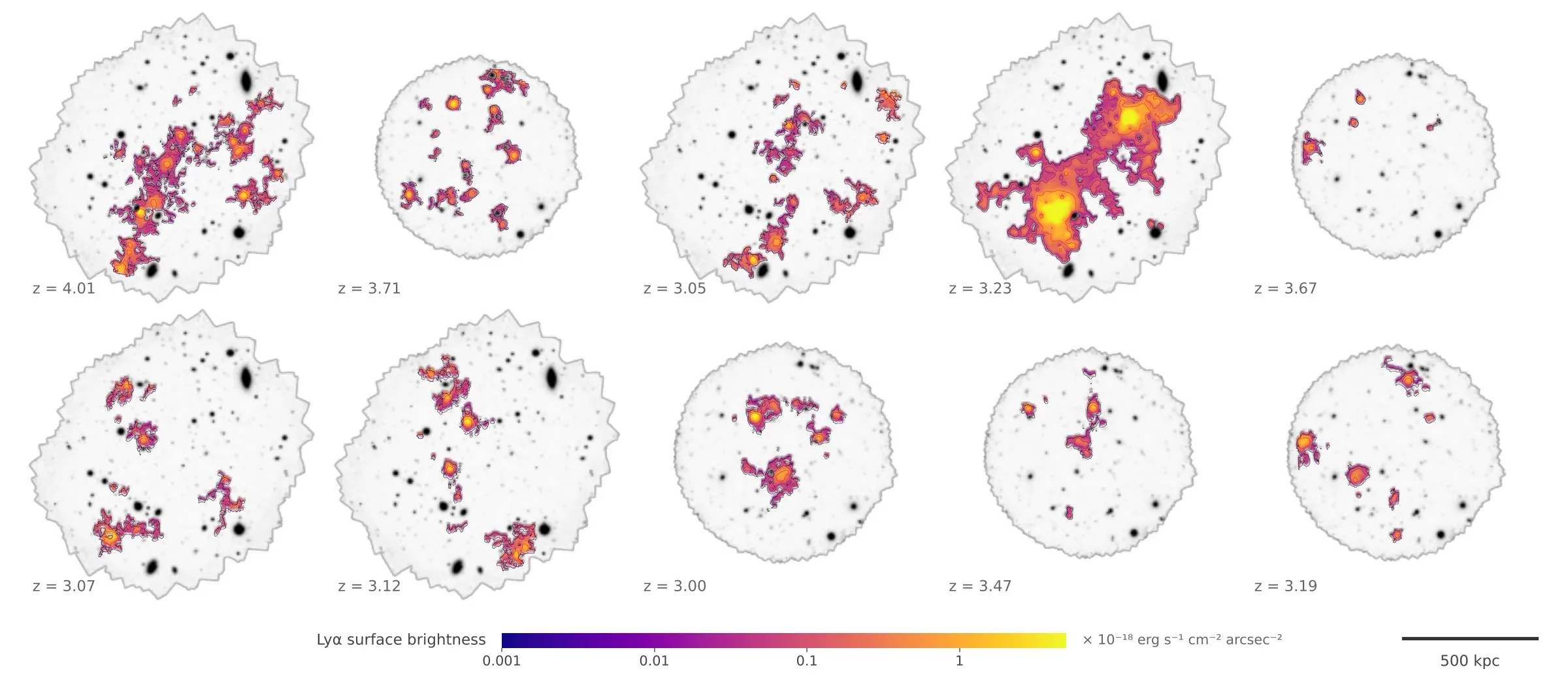
We identified 41 such crowded regions between redshift 3 and 5, when the universe was one to two billion years old. They hold two to ten times more galaxies than average. In about three quarters of them we see faint, extended emission reaching beyond the gas that belongs to individual galaxies: filaments of the web itself, usually lined up with the direction traced by the galaxies.
The environment matters. In the least crowded regions we mostly see nothing. In intermediate regions the brightness varies by about a factor of ten from one structure to the next. In the most crowded regions the emission levels off.
The glowing patches do not fill the filaments. They cover only 20–25 per cent of the area, and the rate at which a random line of sight would cross one matches how often quasar spectra run into Lyman limit systems, the clumps of partially neutral gas that absorption studies have catalogued for decades. That points to what we are actually seeing: the denser spines of filaments and the substructures inside them, with roughly 0.001 to 0.1 hydrogen atoms per cubic centimetre.
Fields this deep will always be few. But stacking many shallower observations, each aligned along its galaxy distribution, should extend this picture to hundreds of structures before the next generation of wide-field spectrographs arrives.