The cosmic web glows even where there is no quasar to light it
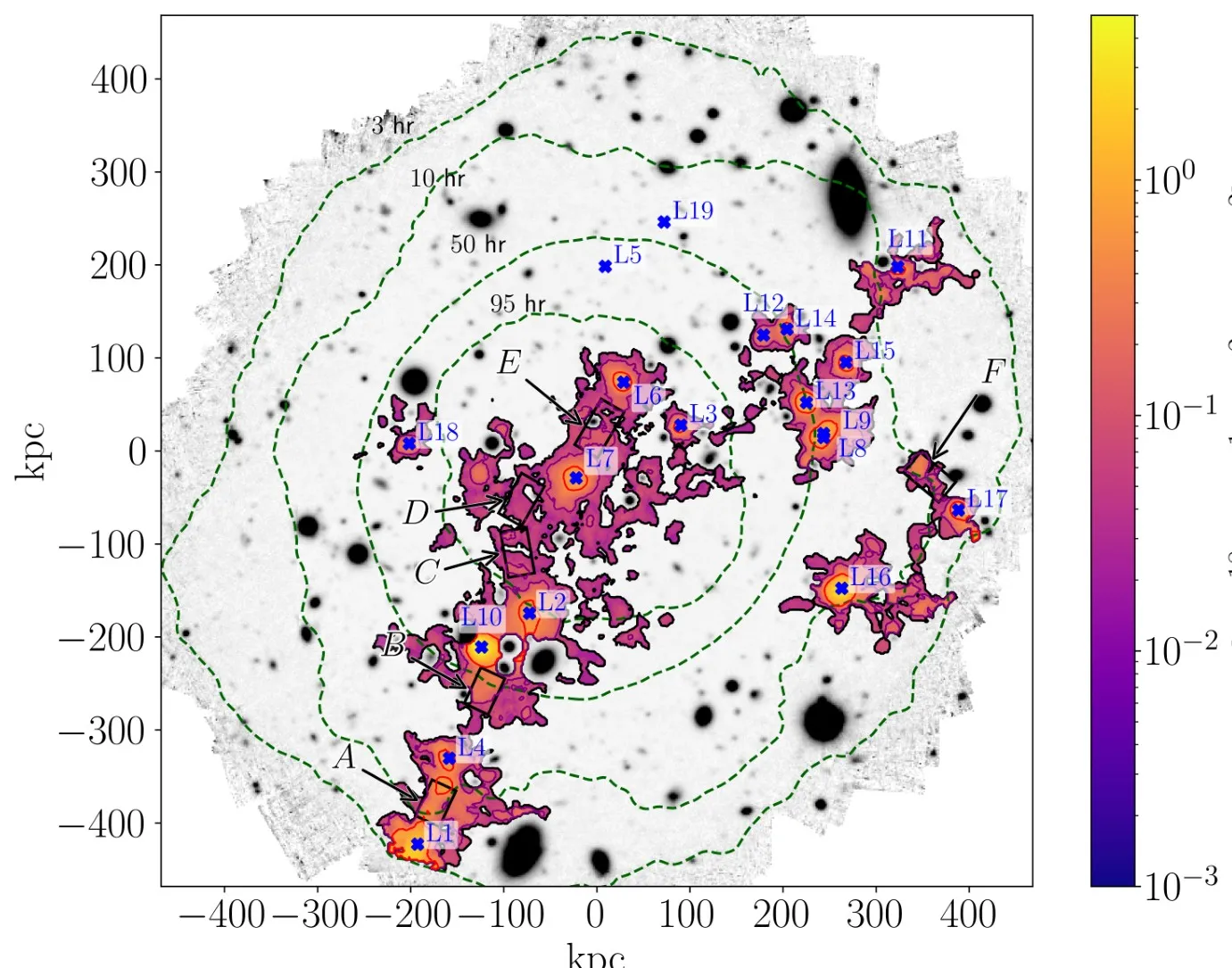
The obvious caveat to photographing a filament between two quasars (see Tornotti et al. 2025, Nature Astronomy) is that you have two quasars in the picture. Quasars are ferociously bright. If gas near them glows, what we observe might not be a general property but a consequence of the presence of quasars.
So we looked at the same field again, at a different distance, where there are none.
At redshift four — about 1.5 billion years after the Big Bang — the MUSE Ultra Deep Field contains a group of nineteen young star-forming galaxies, packed about twenty-five times more densely than an average patch of the universe. Between and around them, the same deep exposure reveals hydrogen glowing at 5 × 10⁻²⁰ erg s⁻¹ cm⁻² arcsec⁻² — a structure roughly 650 kiloparsecs long and 100 across, part of a coherent stretch of cosmic web spanning at least five megaparsecs in comoving units. It is among the largest continuous portions of the web ever imaged rather than inferred.
The number worth dwelling on is that surface brightness. The filament we mapped between the two quasars at redshift three glows at 8 × 10⁻²⁰ — and once you account for the fact that more distant light is dimmed by a factor of about two, this quasar-free filament is at least as bright intrinsically. No quasar required. Whatever is lighting these structures scales with the density of the gas, not with the presence of a spectacular neighbour.
Two further details point the same way. The galaxies embedded in the filament are forming stars somewhat faster than comparable galaxies elsewhere. And five of the seven whose line profiles we can measure show emission peaked on the blue side — the signature expected when gas is falling inwards rather than streaming out.
Which is the picture the theory has always described: filaments as the supply lines along which galaxies are fed. We are now in a position to look at them one at a time.