The gas around a young galaxy sorts itself into three zones
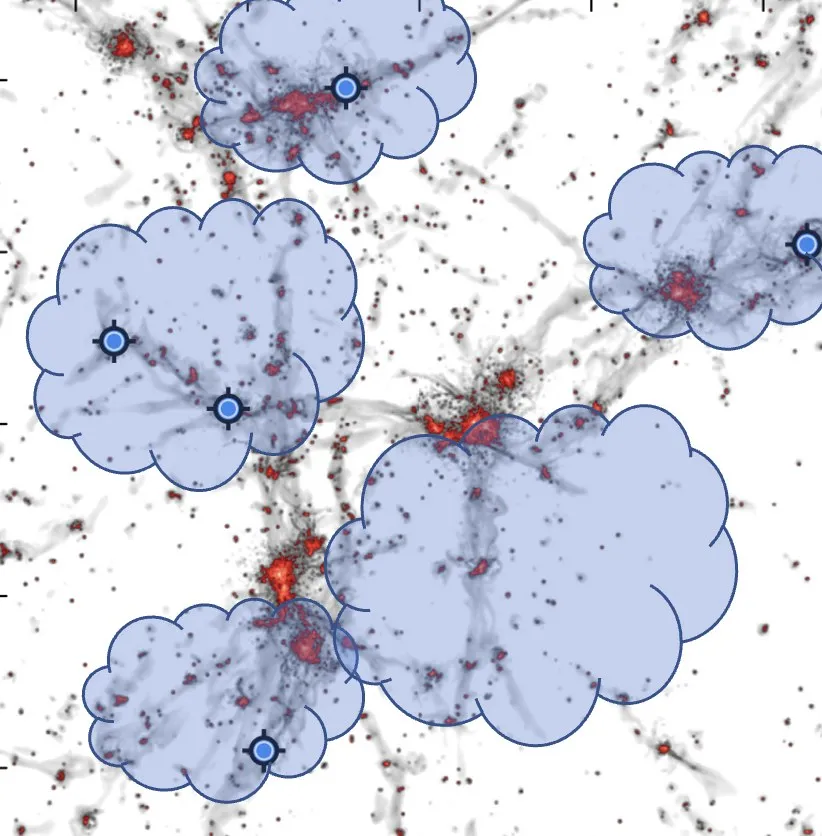
Carbon does not occur naturally in the early universe. Every carbon atom out there was forged inside a star, inside a galaxy, and then somehow got out. Finding those atoms in intergalactic space is a way of asking a question about galaxies: what did they throw away, how far did it go, and when?
Absorption spectroscopy finds the atoms easily. Point a telescope at a distant quasar, and clouds of enriched gas along the way print themselves onto its spectrum. The hard half has always been the other one — working out which galaxy each cloud belongs to, or whether it belongs to any.
Across 28 quasar fields we assembled 220 carbon absorbers at redshifts between three and four and a half, and searched the same volumes for the faint young galaxies that ought to accompany them. Only about a third of the absorbers have a galaxy near them at all. But the ones that do are not randomly distributed, and it is the pattern in the misses as much as the hits that matters.
Three zones, not one
Put this work together with the rest of the MAGG series — which mapped the neutral hydrogen around the same galaxies — and the gas resolves into three distinct components rather than a single halo that fades with distance.
The circumgalactic medium. Closest in, the gas belonging to the galaxy itself. This is where absorption and emission track each other most tightly: strong absorbers sit beside bright galaxies, and the correspondence is unambiguous.
The filaments between galaxies. Farther out, at a few times the radius of a galaxy’s halo, we find more galaxies than a simple halo picture allows — and, tellingly, they prefer to lie along the axis the absorbers define. This is the component that modulates how the strong absorbers behave: it is why the galaxies near them are brighter, and why their clustering runs the way it does. It is gas in the cosmic web, not gas belonging to anyone.
The diffuse enriched medium. Beyond that, the weakest absorbers, farther from any galaxy we can detect, in gas that has been polluted with metals but has no discernible owner at all.
Why it matters
The value of the three-zone picture is that it stops “the gas around galaxies” being a single thing. Each component answers to a different question — how a galaxy holds onto its own material, how the cosmic web feeds it, and how enrichment spread through the intergalactic medium in the first place — and each leaves a different signature in the data.
It also explains the two thirds we do not detect. Those absorbers are not orphans in need of a parent galaxy hiding below our detection limit. Most of them belong to the third component, which has no parent to find.